Sunday, 16 March 2014

Photographer 10 | Chien-Chi Chang

Reading biographies has become my way to seek for inspirations. People around you, people you found in the history, is an easy source of great stories. 

Chien-Chi is the first Chinese member of the Magnum Photos. He was known for photographing the life of illegal immigrants in New York which he started on 1992. This series of work were published in at least five different languages for the National Geographic. In 1998, Time invited  Chien-Chi to explore further on the topic of illegal immigrant in New York. This has lead to a rising global concern about the immigrant issues.

One of the later topic which Chien-Chi has explored is about the life of the psychiatric patients. It was happened in Taiwan that these psychiatric patients were chained under the name of religion. Chien-Chi took these patients into his frames as the silent protest for human rights.

Photography has became a special means for Chien-Chi to interpret social issues. He usually pick sensitive and rare topics to present them in a critical and enthusiastic perspective. 

To me, it is not purely about beauty but photography serves to record history, reflect the pasts and raise social concerns.

Photographer 9 | Raghu Rai

When I go to a situation, I see something interesting, and I see the enormity and the size of it, and the complexity of it, and I say “Yes God, you’ve shown me this but it’s not enough for me.” So he says “Alright.” Then I keep walking, then he shows me something more complex and bigger. I say “Yes God, It’s nice. But it’s still not enough for me.” So I go on and on and I don’t accept it, and then he knows this child of his is very demanding and restless. And then he opens up and shows me something I have never experienced before. Then I take a picture and say “Thank you God.”

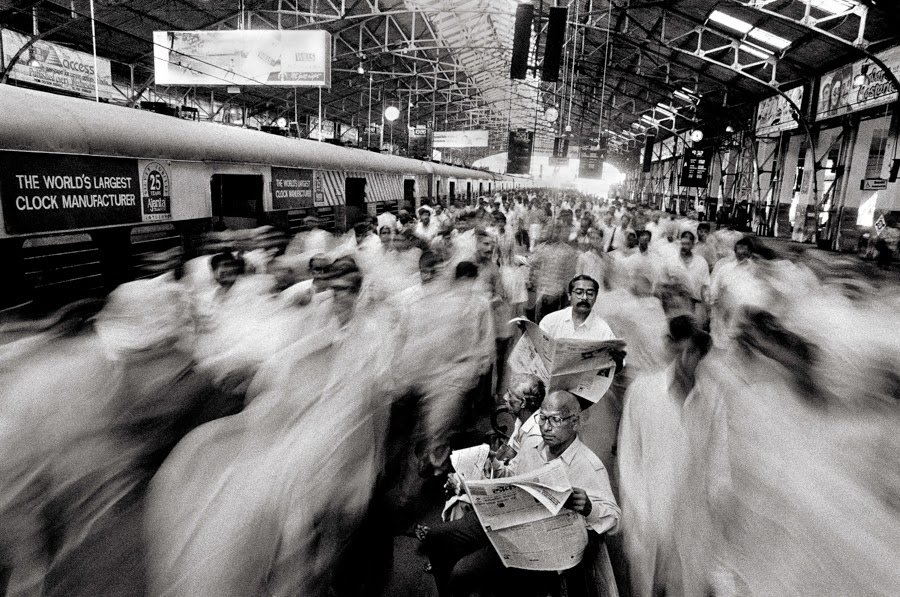
In 1971, Henri Cartier Bresson visited Rai's exhibition at Gallery Delpire, in Paris. He was impressed by his work and later appointed him as the member of Magnum Photos. This has made Rai the first ever Indian being nominated in Magnum Photos.

Rai's motherland, India, has always been the subject of his photography work. He has documented over 4 decades of history and changing socialdscape of India. India is a very interesting country with beautiful variety of cultural and religious aspects. His work best described the people, their livings and the cultures of India.


Monday, 10 March 2014

Photographer 8 | Alexander J.E. Bradley

Bradley, an Australian contemporary street photographer, living in Paris has irrational fear of being at street level which takes him to the heights and depths of the city.

Bradley has an eye catching series called The Great Spectacle of Milking. This series was done by pouring buckets of milk towards his model and he would capture the immediate response of the model. The backdrops that he has chosen include roadside, railway, theme park grass field and etc. The images in this series has demonstrated some decent use of the ambient light to enhance the subjects. 

The clown is likely to be one of the most interesting subjects that favours me in this series. I like that most of the reaction being captured in the frames are natural and interesting. The shape and the texture of milk poured look like some freezing sculptures that are impossible to be seen in our daily occurrences.
  
Bradley's work has inspired me to look for some interesting moments and to create crazy scenes for my future photography work. Photography should be as fun as the viewer can feel it from the frames being captured.

Saturday, 8 March 2014

Photographer 7 | Henri Cartier-Bresson

Henri Cartier-Bresson, was a French photographer known for his master class of candid photography before being named as the father of the photojournalism. His phrase the 'decisive moment' has a great influence among photographers. Then important lesson about the 'decisive moment' is that the best opportunities often flash before our eyes and we must be ready at all times to capture the moments.

Cartier-Bresson's images are sometimes shot by random but other times he had to wait for the right person to pass by to complete the scenes. He usually applied geometrical elements in his images. We can see the integration of vertical, horizontal, and diagonal lines, curves, shadows and etc. He likes to capture the subject along his travel in places such as India, Europe, China, the United States, as well as Africa. Through his work, we observe people of different cultures telling stories that sometimes we encounter in our daily life and other times we had never seen.

SPAIN. Madrid. 1933
SPAIN. Valencia Province. 1933 
France. 1932 
SPAIN. Andulucia. 1933 
INDIA. 1947
INDIA. Autumn 1947
Henri Cartier-Bresson / Magnum Photos
ROMANIA. 1975
Henri Cartier-Bresson / Magnum Photos

Photographer 6 | William Eggleston

Eggleston, an American photographer who is largely credited with the recognition for color photography as a legitimate form to be exhibited in the art galleries. His later work usually features ordinary subject such as old tyres, machines, discarded air-conditioners, vending machines, Coca-Cola bottles, road signs and etc.

The beauty of Eggleston's approach is that he photographs democratically. He would treat every objects as equal. Street photographers usually tend to look for significant characters, interesting gestures and special moments in life as the subject. However, Eggleston is on the opposite. He would frame very ordinary situations and create powerful visual impact out of almost nothing.